|
|
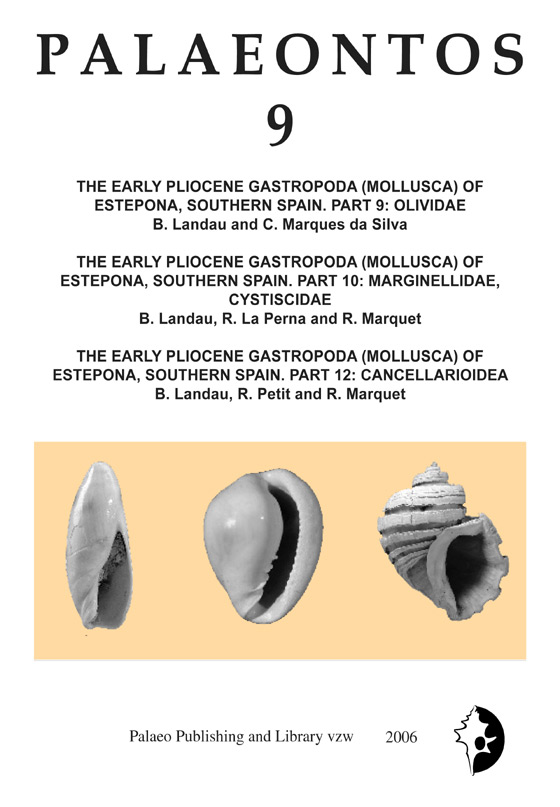
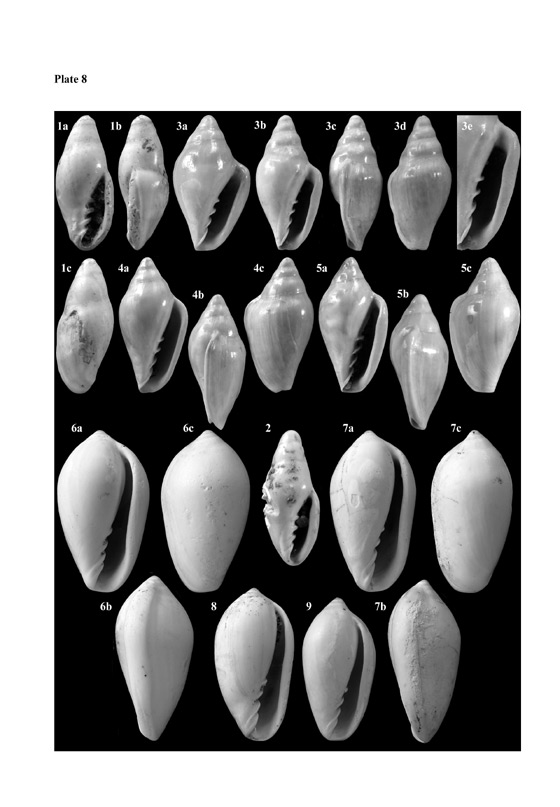
PALAEONTOS 9Price: non members: 40 euros + postage, members: 35 euros + postage 1) Landau B. & Da Silva C.M., 2006, The Early Pliocene Gastropoda (Mollusca) of Estepona, Southern Spain. Part 8: Olividae.(21 textpages, 8 textfigures, 7 tables, 2 plates)Summary: In this part of the series giving a systematic account of the Gastropoda of the Pliocene (Zanclean and lower Piacenzian) deposits of Estepona, province of Málaga, Spain, the Olividae are described and discussed. One new taxon is introduced, Amalda iberica nov. sp. The palaeogeography of the Ancilliinae is discussed, with two hypotheses for their spread; by an ancillid ancestor migrating in situ as part of the biota of Gondwanic continental fragments; by migration from Indo-Pacific stock during the Oligocene. The former is favored, ‘Amalda’ probably representing a polyphyletic group. Not only is the Estepona fauna unique in the Pliocene Mediterranean in having a greater number of species of Olividae than previously known, but also in the abundance of specimens, Olividae being extremely uncommon in other contemporaneous Mediterranean deposits. Although the presence of this olive fauna confirms the more thermophilic character of the Pliocene Mediterranean, Amalda is a cool-temperate genus and it is suggested that the upwelling of cooler, nutrient-rich waters in the Pliocene Alboran Sea is the reason for this wealth in Amalda, and parallels in the Recent faunas are discussed. 2) Landau B., La Perna R. & Marquet R., 2006, The Early Pliocene Gastropoda (Mollusca) of Estepona, Southern Spain. Part 10: Marginellidae, Cystiscidae.(39 textpages, 3 textfigures, 2 tables, 12 plates)Summary: In this part of the series giving a systematic account of the Gastropoda of the Early Pliocene (Zanclean and lower Piacenzian) deposits of Estepona, province of Málaga, Spain, the Marginellidae and Cystiscidae are described and discussed. Seven species are new to science, Marginella iberica nov. sp., Marginella solidula nov. sp., Prunum mediterraneaum, nov. sp., Volvarina alboranensis nov. sp.; Persicula andaluciensis nov. sp., Gibberula mariaconcettae nov. sp. and Gibberula proxima nov sp. Two taxa required a change of name due to the names being junior secondary homonyms, Marginella minima Muñiz-Solis, 2001 is renamed “Dentimargo” lozoueti nov. nom. and Granulina guttula La Perna, 1999 is renamed Granulina mediterranea nov. nom. One further names is emended, Marginella lozanoi to Marginella lozanoae. The faunal composition is compared with that of the Atlantic, North Sea basin, Mediterranean and Paratethys. The generic placement of these species is revised and both the genera Simplicoglabella and Denticuloglabella are synonymised with Marginella. The marginellid fauna from Estepona is unexpectedly much more diverse than in other Pliocene Mediterranean sectors, with twenty-four species representing six genera. This Pliocene marginellid fauna is notably different from that found in the Mediterranean Miocene, which seems not to have survived the Messinian salinity crisis. The new stock probably originated from the Atlantic and thrived in the nutrient-rich waters of the Pliocene Alboran Sea, but did not penetrate further into the Mediterranean. The marginellids suffered dramatically from the gradual climatic cooling during the Pliocene, with only four of the 24 species surviving to the present day. Today, a fauna similar in wealth of species and composition occurs further south, off the northwestern coast of Africa. Apart from the occurrence of a single species of Persicula, the cystiscid fauna from Estepona is represented by four species of Gibberula, which reflect both the modern Mediterranean and adjacent Atlantic stock, and the Italian Pliocene one. 3) Landau B., Petit R. & Marquet R., 2006, The Early Pliocene Gastropoda (Mollusca) of Estepona, Southern Spain. Part 10: Cancellarioidea.(41 textpages, 1 table, 9 plates)Summary: In this part of the series giving a systematic account of the Gastropoda of the Early Pliocene (Zanclean and lower Piacenzian) deposits of Estepona, province of Málaga, Spain, the Cancellarioidea are described and discussed, with special attention to protoconch morphology. None of the 18 taxa encountered are new to science, Admetula malacitana Vera-Peláez & Muñiz-Solis, 1995, originally described as endemic to the Estepona deposits is synonymised with Contortia italica (D’Ancona, 1872). The faunal composition is compared with that of the Atlantic, North Sea basin, Mediterranean and Paratethys. The generic placement of these species is revised and it is here suggested that the genus Calcarata is closely related to Trigonostoma. The European cancellarid lineages and species groups are well established since the early Neogene and most of the species arise in the Middle-Late Miocene. The Cancellariidae suffered dramatically from the gradual climatic cooling during the Pliocene, with only three of the 18 species surviving to the present day, two of which now have a more southerly distribution, being confined to the West African coasts. |
|
ORDER INFORMATION:please contact us at: palaeontos@gmail.com |
|