|
|
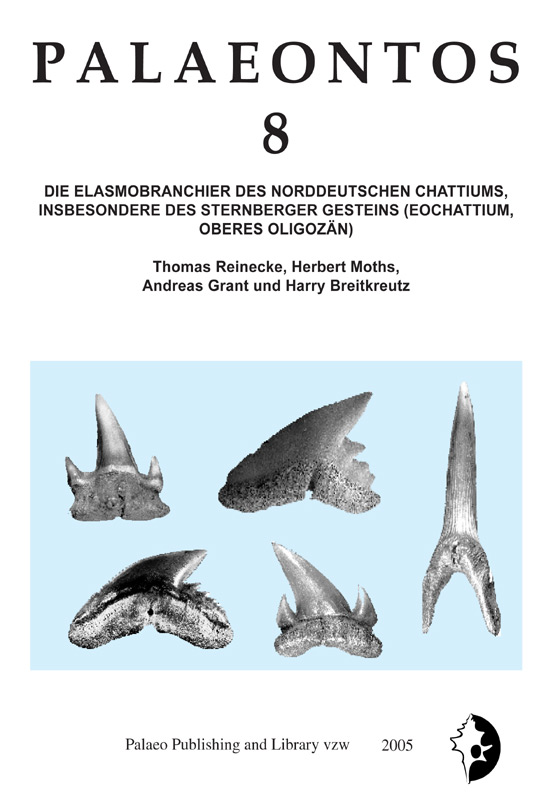
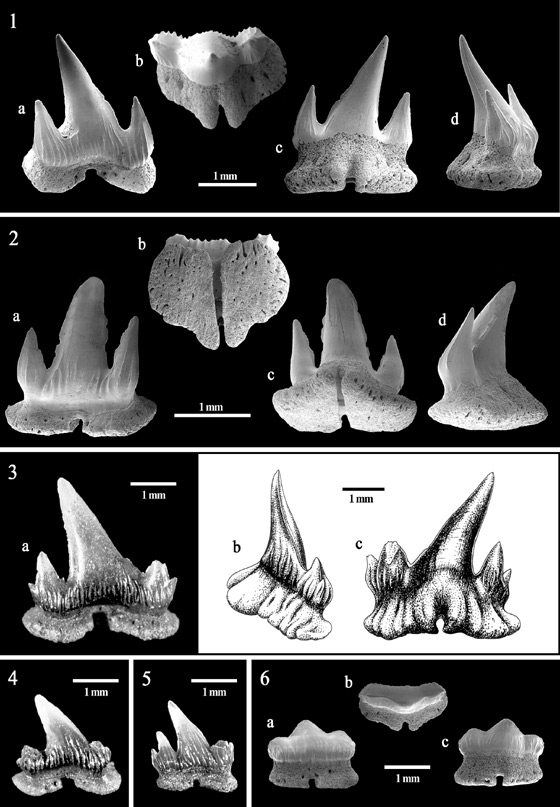
PALAEONTOS 8Price: non members: 40 euros + postage, members: 35 euros + postage Reinecke T., Moths H., Grant A. & Breitkreutz H., 2005, Die Elasmobranchier des norddeutschen Chattiums, insbesondere des Sternberger Gesteins (Eochattium, Oberes Oligozän)(135 textpages, 15 textfigures, 3 tables, 60 plates)Summary: Glaciofluviatile fossiliferous boulders, known as Sternberger Gestein, occur in northern Germany in the area of Schwerin-Sternberg (Mecklenburg-Vorpommern). Stratigraphically, they are equivalent to the sandy-silty, sublittoral Sülstorf Beds (Eochattian, Late Oligocene of the southeastern North Sea Basin). These boulders contain a diverse subtropical elasmobranch fauna of 24 shark and 10 batoid taxa, of which 21 and 3 could be identified at species level. Fossil remains include isolated oral teeth, caudal stings, thorns, gill rakers, and scales. The fauna is dominated by sharks living as recent taxa in the mesotrophic-littoral (Carcharias, Physogaleus, Carcharhinus, Squalus), the mesobenthic-littoral (four scyliorhinid taxa), the eurytrophic-littoral (Notorynchus, Galeocerdo) and microtrophic-littoral (Cetorhinus) realm. The genus Carcharias is represented by three taxa, one of which is new: Carcharias sternbergensis. As recent taxa epipelagic (Isurus, Alopias) and mesobathic (Hexanchus, Mitsukurina) sharks and the large predator Carcharocles angustidens are rarely recorded. More than 97% of the batoid teeth belong to the benthic genera Raja and Dasyatis and the aquilopelagic genus Myliobatis. The batoid genera Torpedo and Gymnura and the shark genera Hexanchus and Mitsukurina are recorded for the first time in the Chattian of the North Sea Basin. The new scyliorhinid genus Pachyscyllium is erected, including three species: P. albigensis sp. nov. (Rupelian, Mainz Basin), P. braaschi sp. nov. (Chattian, North Sea Basin), and P. venloensis (Weiler, 1943) (Hemmoorian, North Sea Basin). Elasmobranch faunas of the Doberg Formation (Eochattian and Neochattian) and Kassel Formation (Eochattian), both from the southern North Sea Basin, are similar to the Sternberg fauna. They are, however, less well-known because taxa with small teeth are rare due to lack of sampling finer residues. Isurolamna und Parotodus are presently known from the Doberg and Kassel Formation only. The changes in the elasmobranch faunas from the Rupelian to the Hemmoorian are described and discussed with respect to ecology, palaeogeography and the climate. |
|
ORDER INFORMATION:please contact us at: palaeontos@gmail.com |
|