|
|
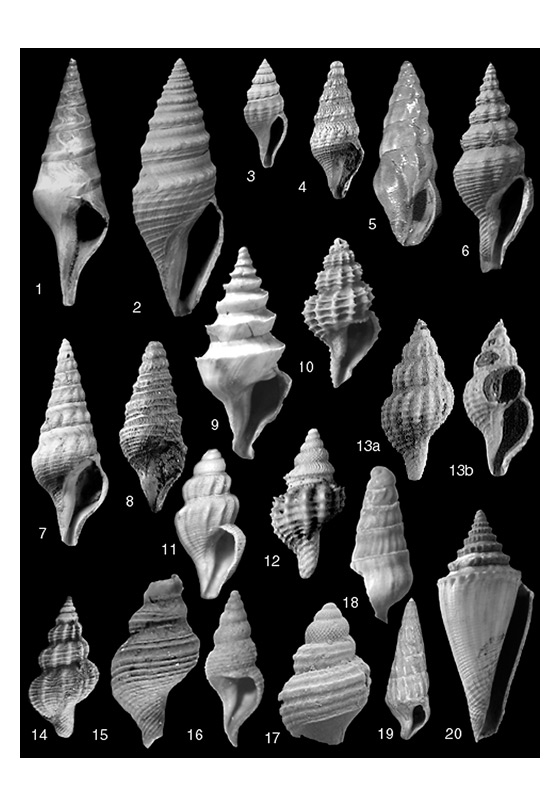
PALAEONTOS 7In collaboration with the Midtsønderjyllands Museum at Gram, DenmarkPrice: non members: 40 euros + postage, members: 35 euros + postage 1) Rasmussen E.S., 2005, The geology of the upper Middle - Upper Miocene Gram Formation in the Danish area.(14 textpages, 10 textfigures)Summary: Sediments of the upper Middle - Upper Miocene Gram Formation are distributed in central, west and south Jylland, Denmark. The Gram Formation is subdivided into three units: bottom to top the glaucony-rich, lowermost part, the Gram Clay, and the Gram sand. The sediments of the Gram Formation were deposited in an open marine depositional environment. The sediments of the Gram Formation were deposited in an open-marine environment. The glaucony-rich part was laid down under maximum transgression of the sea during the late Middle Miocene, when the north-eastern boundary of the North Sea was possibly located near the Sorgenfrei-Tornquist Zone in northern Jylland and Skåne. Water depths were up to 100 m in the area covered by the present-day west Jylland, but exceeded 500 m in the central part of the North Sea. In the Upper Miocene, outbuilding of clastic sedimentary wedges from the Fennoscandian Shield occurred from both the north and east. This resulted in a high sedimentation rate during the deposition of the Gram Clay. Locally, especially around salt structures, deeper, partly anoxic, restricted depositional environments prevailed. Expansion of these anoxic environments may have resulted in extreme environmental conditions and resulted in mass mortality shown by well-defined concretion horizons containing impressions of crabs. The uppermost part of the Gram Clay, with fine-grained storm-sand layers, and the Gram sand indicate periodical proximity of the shoreline. Possibly as a result of increased subsidence of the North Sea Basin in the Upper Miocene, up to 400 m of mainly shelfal deposits were laid down in most parts of the eastern North Sea Basin. 2) Beyer C., 2005, A magnetic analysis of the Late Miocene Gram Formation, Denmark.(10 textpages, 8 textfigures)Summary: Based on the assumption that the geomagnetic secular variation in the Late Miocene posessed characteristics similar to the Quaternary secular variation, the accumulation rates of the Miocene Gram Formation was estimated by a magnetic analysis of a 16m vertical profile. The magnetic susceptibility, intensity and direction were measured and interpreted with respect to grain size, magnetic polarity and variation of the rate of accummulation. The analyses showed a general increase of accummulation rate upwards in the profile from approximately 0.03mm/y to 0.40mm/y. The sedimentation was extremely slow and possibly discontinuous in the lowermost part of the sequence, part of which is interpreted as a condensed section. The rest of the sampled profile showed more rapid and relatively continuous sedimentation during a time of normal polarity. A reverse polarity zone of 1.6m thickness was revealed in the interval 1.2 - 2.8m. The duration of this polarity zone is estimated to less than 70.000 years which leaves only three possibilities for correlation to the GPTS for the Tortonian stage, approximately 7.1 m.y., 7.4 m.y. or 9.9 m.y. The results indicate that the lowermost 3m were deposited during approximately 100.000 years and the 8m above this interval were deposited during approximately 20.000 years. The lowermost 8 m of the formation was not accessible in the clay pit but is known from nearby wells. This part of the sequence contains glauconite sand at the base and was thus deposited considerably slower than the studied sequence. 3) Piasecki S., 2005, Dinoflagellate cysts of the Middle – Upper Miocene Gram Formation, Denmark.(17 textpages, 4 textfigures, 3 plates)Summary: The dinoflagellate cysts of the Gram Formation provide the biostratigraphic framework for the determination of the age of the formation and reflect environmental and palaeoclimatic conditions during deposition. The age of the Gram Formation is Late Serravallian and Tortonian (late Middle Miocene to early Upper Miocene) estimated on the basis of dinoflagellate cyst biostratigraphy; the basal glaucony-rich interval is referred to late Serravallian, and the overlying clays, silts and fine-grained sands are assigned to the Tortonian. These age assignments are not consistent with the ages based on molluscs and the foraminifers; for example, dinoflagellate cysts indicate no Messinian strata in the Gram Formation whereas the foraminifer stratigraphy does. Such stratigraphic contradictions are discussed. Significant variations in the diversity and abundance of the dinoflagellate cyst assemblages are interpreted to reflect relative sea-level variations; maximum flooding is inferred in the basal Gram Formation followed by steady shoreline progradation such that the uppermost levels at the Gram locality represents a coast-near setting. In localities further to the west and south, more marine floras occur in the uppermost part of the formation. The dinoflagellate cyst assemblage reflects the cooling climate during deposition of the Gram Formation. Genera and species persistently present from the Palaeogene disappear up through the succession, probably reflecting the deteriorating climate. Species with tropical – subtropical affinity occur in the underlying Hodde Formation but disappear in the Gram Formation. However, the response of Neogene dinoflagellate cyst assemblages to climatic and environmental parameters are not well elucidated, and detailed interpretations of the Gram flora are premature. 4) Hansen J. & Hansen T., 2005, A Late Miocene brissid echinoid from Denmark.(5 textpages, 2 textfigures, 1 plate )Summary: Numerous specimens of the irregular echinoid Brissopsis lyrifera have been collected from the Gram Formation (Upper Miocene) at Gram clay pit, Denmark, and these are the oldest known records of the species. Although poorly preserved, the tests closely resemble the extant Danish form of B. lyrifera. This indicates the species has shown evolutionary stasis over the last eight million years. 5) Fraaije R., Hansen J. & Hansen T., 2005, Late Miocene decapod faunas from Gram, Denmark.(11 textpages, 4 textfigures, 1 plate.Summary: Six species of decapod crustacean (two macrurans, one anomuran, three brachyurans) are recognised from upper Miocene strata exposed at the Gram clay-pit, south-west Jutland, Denmark. Three new species, Retropluma borealis, Chaceon miocenicus, and Nephrops kvistgaardae, are erected; the genera Tasadia and Munida are recorded from the Danish Miocene for the first time. 6) Schnetler K.I., 2005, The Mollusca from the stratotype of the Gram Formation (Late Miocene, Denmark).(128 textpages, 6 textfigures, 11 plates)Summary: The mollusc fauna of the Gramian stratotype, the clay-pit of the former Gram Brickworks, was studied. The material from the Gramian part of the borehole Gram 1 (D.G.U. 141.277; 5.30 – 16.50 m) is also included. The study gives a summary of our present knowledge of the fauna. A total of 128 species of mollusca is recorded, of which 36 are new for the Gram locality. Five new species and one new subspecies are established, viz. Mesopelex anderseni n. sp., Galeodea bicatenata marqueti n. subsp., Nassarius (Tritonella) ronaldjansseni n. sp., Teretia guersi n. sp., Daphnella abrahamssoni n. sp. and Turbonilla (Strioturbonilla) rothi n. sp. The new name Skenea ariejansseni nom. nov. is introduced for Skenea minuta A.W. Janssen, 1967 (non Jeffreys, 1883). A lectotype for Pleurotomoides luisae (Von Koenen, 1872) is designated. Remarks on taxonomy and palaeogeography are given. The Nassariidae will be revised in a separate paper (Gürs & Schnetler, in prep.). |
|
ORDER INFORMATION:please contact us at: palaeontos@gmail.com |
|