|
|
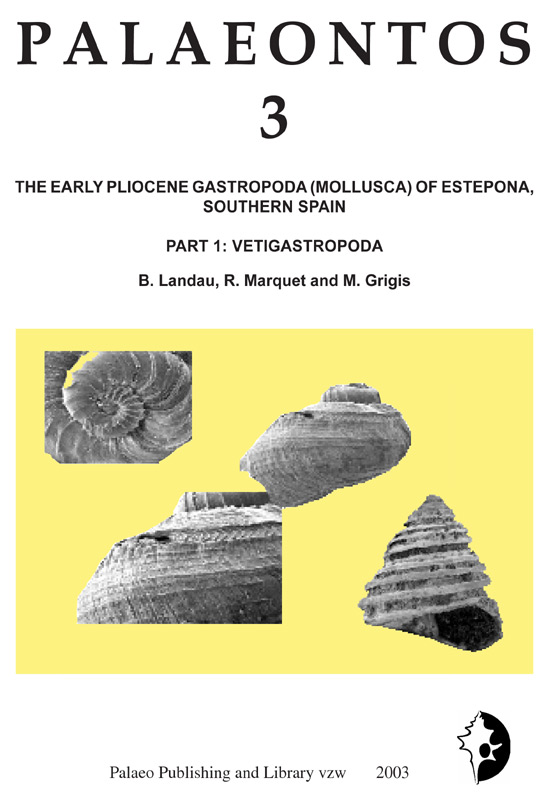
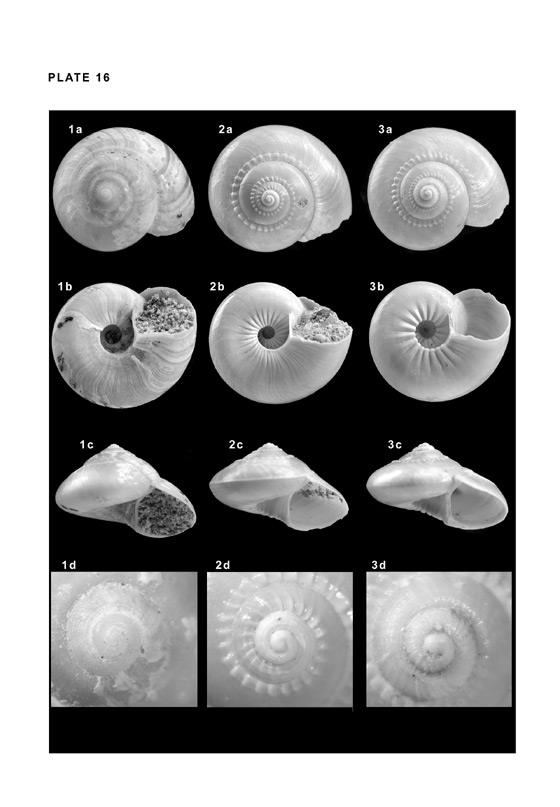
PALAEONTOS 3Price: non-members: 40 euros, members: 35 euros Landau B., Marquet R. & Grigis M., 2003, The Early Pliocene Gastropoda (Mollusca) of Estepona, Southern Spain. Part 1. Vetigastropoda(87 textpages, 2 textfigures, 2 tables, 19 plates)Summary: In this work, a systematic account is given of the Gastropoda (Eogastropoda) of the Lower Pliocene (Zanclean and Early Piacenzian) deposits of Estepona, province of Málaga, Spain. The localities and their depositional and taphonomic characters are described. Until now only unillustrated lists and papers covering parts of the malacofauna have been published. The Eogastropoda are figured, described and discussed. 79 species of Eogastropoda were encountered, most of them new to the study area. Six taxa are new to science: Haliotis iberica nov. sp., Agariste juliencilisi nov. sp., Bolma baccata mariachristinae nov. subsp., Jujubinus annamarieae nov. sp., Gibbula spadinii nov. sp. and Solariella wareni nov. sp. Microgaza solarioides (Seguenza, 1876) non Deshayes, 1863 is renamed Microgaza Seguenzae nov. nom. The fauna is remarkably rich in species and is undoubtedly the most important Early Pliocene assemblage outside Italy. This is due, in part, to the variety of facies, representing nearshore to deeper water deposits, all present within a very small geographical area. The faunal composition is further enriched by the unique geographical position of the deposits, close to the Straits of Gibraltar, resulting in the presence of species with an Atlantic influence together with the expected Pliocene Mediterranean species. Of even greater interest are the endemic species and a small Miocene relict fauna, which seems to have survived into the Early Pliocene in the relative 'sanctuary' of the Málaga basin. |
|
ORDER INFORMATION:please contact us at: palaeontos@gmail.com |
|