|
|
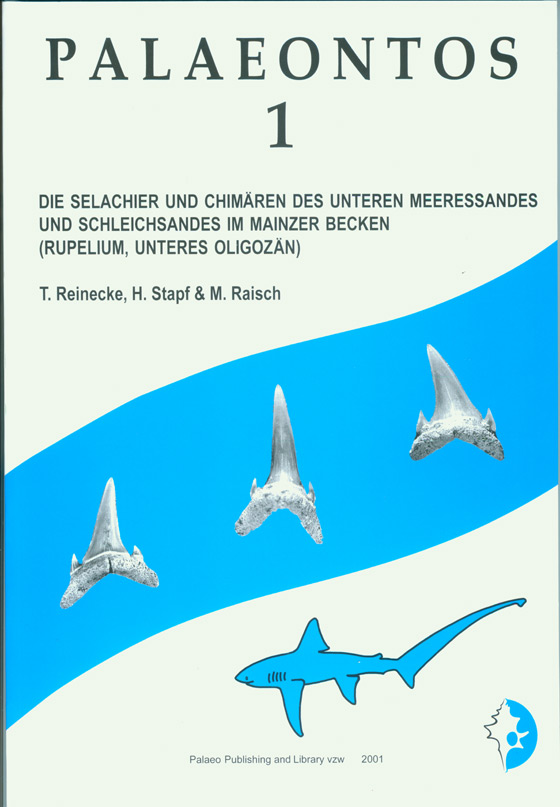
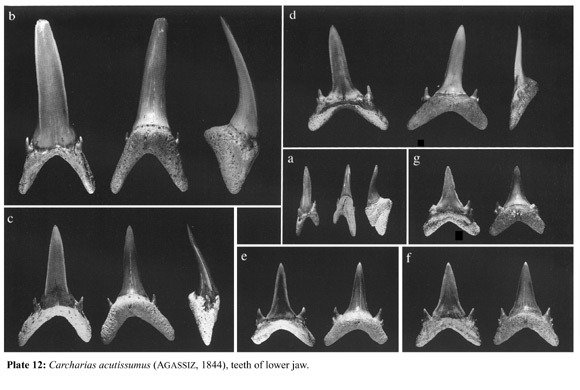
PALAEONTOS 1Price: members: 30 € + postage, non-members: 35 € + postage Reinecke T., Stapf H. & Raisch M., 2001, Die Selachier und Chimären des unteren Meeressandes und Schleichsandes im Mainzer Becken (Alzey- und Stadecken Formation, Rupelium, Unteres Oligozän).(73 textpages, 8 text-figs, 2 tables, 63 plates (text is in German, description of new species and legends to the plates are also in English)Summary: Oral teeth, gill rakers, caudal stinging spines and tooth plates of the Chondrichthyan fauna (18 shark species, 4 batoids and 1 chimaera) from the Lower Meeressand (Alzey Formation) and Schleichsand (Stadecken Formation), Rupelian, Lower Oligocene of the Mainz Basin (Germany) are figured and partly redescribed. One species is new to science: Woellsteinia oligocaena n.g. n.sp. (Galeomorphii, Lamniformes, Mitsukurinidae). The shark Lamiostoma gracilis is referred to the genus Isurolamna. The elasmobranch assemblages at most localities of the Alzey Formation are dominated by Carcharias acutissimus (Agassiz, 1844); Carcharias cuspidatus (Agassiz, 1844); Physogaleus latus (Storms, 1894); Squatina angeloides Van Beneden, 1873; Mytliobatis (sensu lato) sp. 2; Notorynchus primigenius (Agassiz, 1843) and the filter feeder Cetorhinus parvus Leriche, 1908. Much less common, but almost constantly present are Squalus alsaticus (Andreae, 1892); Isurolamna gracilis (Le Hon, 1871); Carcharhinus elongatus (Leriche, 1910); Dasyatis aff. delfortrei Cappetta, 1970; Rhinoptera sp. and three scyliorhinid species. The rarity or even apparant absence of Scyliorhinus, Dasyatis and Squalus at some localities may be biased by the sampling methods and the small size of their teeth. Large pelagic species of the Rupelian, such as Carcharocles angustidens (Agassiz, 1843) and Parotodus benedeni (Le Hon, 1871), as well as Alopias exigua (Probst, 1879); Galeorhinus sp.; Galeocerdo aduncus Agassiz, 1843; Raja sp. and the mitsukurinid shark Woellsteinia oligocaena n.g. n.sp. are very uncommon. Three species occurring in the North Sea Basin, Lethenia vandenbroecki (Winkler, 1880); Pristiophorus rupeliensis Steurbaut & Herman, 1978 and the mobulid ray Plinthicus kruibekensis Bor, 1990 have not been found in the Mainz Basin thus far. The apparent absence of Woelsteinia oligocaena in the North Sea Basin and the presence of a closely related species in the Middle to Late Eocene of Kazakhstan is in line with Weiler's (1928) conclusion that the elasmobranch fauna of the Rupelian in the Mainz Basin was strongly influenced by the Tethyan realm. |
|
ORDER INFORMATION:please contact us at: palaeontos@gmail.com |
|